<?xml version="1.0" encoding="utf-8"?>
<feed xmlns="http://www.w3.org/2005/Atom">
    <title>Ari Davidow: Hebrew Typesetter Extraordinaire</title>
    <link rel="alternate" type="text/html" href="http://www.ivritype.com/hebrew/" />
    <link rel="self" type="application/atom+xml" href="http://www.ivritype.com/hebrew/atom.xml" />
    <id>tag:www.ivritype.com,2013-04-23:/hebrew//6</id>
    <updated>2015-07-18T23:10:58Z</updated>
    <subtitle>I spent much of the late 1980s and 1990s working on Hebrew typography. I&apos;m back (and available for Yiddish and Hebrew typography). I was lured by the promise of OpenType, Unicode Hebrew on the web, and my original love of Hebrew typography. It all makes for information that wants to be shared.
</subtitle>
    <generator uri="http://www.sixapart.com/movabletype/">Movable Type 4.38</generator>

<entry>
    <title>Can you help identify/place this Hebrew font?</title>
    <link rel="alternate" type="text/html" href="http://www.ivritype.com/hebrew/2015/07/can-you-help-id.php" />
    <id>tag:www.ivritype.com,2015:/hebrew//6.14005</id>

    <published>2015-07-18T23:01:27Z</published>
    <updated>2015-07-18T23:10:58Z</updated>

    <summary>Philipp Messner is putting together a small exhibit on Hebrew typographer for the Israel Museum this fall. The exhibit will focus on three book and type designers: Franziska Baruch, Henri Friedlaender and Moshe (Moritz) Spitzer, but his chart covers a...</summary>
    <author>
        <name>Ari Davidow</name>
        
    </author>
    
        <category term="fonts" scheme="http://www.sixapart.com/ns/types#category" />
    
    
    <content type="html" xml:lang="en" xml:base="http://www.ivritype.com/hebrew/">
        <![CDATA[<p>Philipp Messner is putting together a small exhibit on Hebrew typographer for the Israel Museum this fall. The exhibit will focus on three book and type designers: Franziska Baruch, Henri Friedlaender and Moshe (Moritz) Spitzer, but his chart covers a wider variety of 20th century metal type. He has the following sample:</p>

<p><a href="http://www.ivritype.com/hebrew/images/2015-07-18-HaMahar.jpg"><img src="http://www.ivritype.com/hebrew/images/2015-07-18-HaMahar.jpg" width="800" height="71" alt="type sample" /></a></p>

<p>He writes: "I found it on the cover of one of the first editions of the Hebrew avant-garde magazine "HaMahar" (edited by Avidgor Hameiri and published 1927-1940 in Tel Aviv and New York). I only got it in this poor quality but it seems to be printed type (the letters are used for different issues, not only for this motto, but for numbering etc.)."</p>

<p>Please contact me if you can identify it, or know anything about the magazine, etc., and I'll pass the word onto Philipp. </p>]]>
        
    </content>
</entry>

<entry>
    <title>The Hebrew Types of Mishkan HaNefesh</title>
    <link rel="alternate" type="text/html" href="http://www.ivritype.com/hebrew/2015/06/the-hebrew-type.php" />
    <id>tag:www.ivritype.com,2015:/hebrew//6.13902</id>

    <published>2015-06-18T18:33:34Z</published>
    <updated>2015-06-18T18:38:28Z</updated>

    <summary>I recently had lunch with typographer/designer Scott-Martin Kosofsky. Talk turned to the face he designed for the new Reform Movement Makkzor, he just finished designing and composing. As was the case with the Conservative movement&apos;s Makhzor he completed a few...</summary>
    <author>
        <name>Ari Davidow</name>
        
    </author>
    
    <category term="hebrewtypographymakhzormachzor" label="hebrewtypography makhzor machzor" scheme="http://www.sixapart.com/ns/types#tag" />
    
    <content type="html" xml:lang="en" xml:base="http://www.ivritype.com/hebrew/">
        <![CDATA[<p>I recently had lunch with typographer/designer Scott-Martin Kosofsky. Talk turned to the face he designed for the new Reform Movement <em>Makkzor</em>, he just finished designing and composing. As was the case with the Conservative movement's <em>Makhzor</em> he completed a few years ago, the result is a pair of stunning books. On arriving home, I discovered email from a long-time friend with a link to Scott's article on the subject for the Reform Rabbi's blog. Before I lose track of it, I am posting it to this blog.</p>

<p><a href="http://ravblog.ccarnet.org/2015/06/hebrew-types-mishkan-hanefesh/">The Hebrew Types of Mishkan HaNefesh</a>, June 2, 2015, by Scott-Martin Kosofsky</p>]]>
        
    </content>
</entry>

<entry>
    <title>new Comprehensive Yiddish-English Dictionary</title>
    <link rel="alternate" type="text/html" href="http://www.ivritype.com/hebrew/2013/03/new-comprehensi.php" />
    <id>tag:www.ivritype.com,2013:/hebrew//6.11363</id>

    <published>2013-03-03T22:21:16Z</published>
    <updated>2013-03-03T22:31:31Z</updated>

    <summary>I would be remiss if I didn&apos;t mention the existence of a wonderful new Comprehensive Yiddish-English Dictionary. There was a party at the Brookline Workmen&apos;s Circle this afternoon to celebrate, and I got to shmooze with several of the editors....</summary>
    <author>
        <name>Ari Davidow</name>
        
    </author>
    
    <category term="yiddish" label="Yiddish" scheme="http://www.sixapart.com/ns/types#tag" />
    
    <content type="html" xml:lang="en" xml:base="http://www.ivritype.com/hebrew/">
        <![CDATA[<img src="http://www.iupress.indiana.edu/images/books/9780253009838_med.jpg" alt="book cover" height="220" width="154" /><p>I would be remiss if I didn't mention the existence of a wonderful new <a href="http://www.amazon.com/gp/product/0253009839/ref=as_li_qf_sp_asin_tl?ie=UTF8&camp=1789&creative=9325&creativeASIN=0253009839&linkCode=as2&tag=aridavidow">Comprehensive Yiddish-English Dictionary</a><img src="http://www.assoc-amazon.com/e/ir?t=aridavidow&l=as2&o=1&a=0253009839" width="1" height="1" border="0" alt="" style="border:none !important; margin:0px !important;" />. There was a party at the Brookline Workmen's Circle this afternoon to celebrate, and I got to shmooze with several of the editors. We also picked up a copy of the dictionary to the house.</p>

<p>What makes this dictionary special is that it covers <em>all</em> terms used in Yiddish, not just the ones that Weinreich felt were ממש Yiddish. For someone learning the language, who doesn't also speak several Slavic languages, German, Polish, etc., this is an essential tool.</p>

<p>The dictionary is also available online. You don't need another book (or you can purchase the dictionary, and still have access to the words while on the road). See <http://www.verterbukh.org/>www.verterbukh.org</a>.</p>

<p>I should also mention some disappointment with the Yiddish font. It is a reasonably well-designed "modern" (the style of type design popular around the turn of the last century) face, but I would have encouraged consideration of more recent alternatives such as Narkissim or Hadassah, or, if an old-style face was desired, to consider a premium commercial typeface. Still, the font is readable enough, and the existence of the book is a major joy. Let's leave it at that.</p>

]]>
        
    </content>
</entry>

<entry>
    <title>Modern typos</title>
    <link rel="alternate" type="text/html" href="http://www.ivritype.com/hebrew/2012/06/modern-typos.php" />
    <id>tag:www.ivritype.com,2012:/hebrew//6.10790</id>

    <published>2012-06-15T12:02:53Z</published>
    <updated>2012-06-15T12:04:26Z</updated>

    <summary>Andrew Tannenbaum forwarded this link to me. The wonders of technology in helping create, and then other technology in confounding, poor communication ;-). http://frgdr.com/blog/2012/05/31/jews-do-not-run-hollywood-the-proof/ Back to a real blog real soon - coding is finally moving forward....</summary>
    <author>
        <name>Ari Davidow</name>
        
    </author>
    
        <category term="links" scheme="http://www.sixapart.com/ns/types#category" />
    
    
    <content type="html" xml:lang="en" xml:base="http://www.ivritype.com/hebrew/">
        Andrew Tannenbaum forwarded this link to me. The wonders of technology in helping create, and then other technology in confounding, poor communication ;-).

http://frgdr.com/blog/2012/05/31/jews-do-not-run-hollywood-the-proof/

Back to a real blog real soon - coding is finally moving forward.
        
    </content>
</entry>

<entry>
    <title>Hadassah copyright infringement</title>
    <link rel="alternate" type="text/html" href="http://www.ivritype.com/hebrew/2011/09/hadassah-copyri.php" />
    <id>tag:www.ivritype.com,2011:/hebrew//6.10257</id>

    <published>2011-09-25T15:36:05Z</published>
    <updated>2011-09-25T15:43:24Z</updated>

    <summary><![CDATA[I heard elements of this case back when I was in Israel this past December. I wish I understood more&mdash;whether or not Friedlander gave up the rights to Hadassah and made it public domain back in the 1950s or not,...]]></summary>
    <author>
        <name>Ari Davidow</name>
        
    </author>
    
        <category term="fonts" scheme="http://www.sixapart.com/ns/types#category" />
    
        <category term="links" scheme="http://www.sixapart.com/ns/types#category" />
    
        <category term="typography" scheme="http://www.sixapart.com/ns/types#category" />
    
    <category term="hadassah" label="hadassah" scheme="http://www.sixapart.com/ns/types#tag" />
    <category term="hebrew" label="hebrew" scheme="http://www.sixapart.com/ns/types#tag" />
    
    <content type="html" xml:lang="en" xml:base="http://www.ivritype.com/hebrew/">
        <![CDATA[<p><em>I heard elements of this case back when I was in Israel this past December. I wish I understood more&mdash;whether or not Friedlander gave up the rights to Hadassah and made it public domain back in the 1950s or not, how long does copyright extend? Beyond the law, to what extend did or should Tvika Rosenberg owe Friedlander or his heirs, regardless? In any event, a Jerusalem court ruled last week that Friedlander's granddaughter owns the rights, and that Masterfont, Rosenberg's company, owes. Here are the details from <em>Ha-aretz</em>.</p>

<p><a href="http://www.haaretz.com/print-edition/news/court-inventor-s-heirs-own-hadassah-hebrew-typeface-1.385673">Court: Inventor's heirs own Hadassah Hebrew typeface: Daughter of man who designed classic font about 70 years ago victorious in copyright infringement suit</a>, by Yuval Saar</p>

<p>&hellip; In 2009, Hannah Tal filed a NIS 4.5 million copyright infringement suit against the Israeli company Masterfont for selling the popular typeface created by her father, Henri Friedlaender, for many years without her consent. Ayala Tal, Hannah Tal's daughter and Friedlaender's granddaughter, works at Haaretz as a graphic artist&hellip;. [<a href="http://www.haaretz.com/print-edition/news/court-inventor-s-heirs-own-hadassah-hebrew-typeface-1.385673">more</a>] </p>
]]>
        
    </content>
</entry>

<entry>
    <title>A book on Hebrew Typography? What would it contain?</title>
    <link rel="alternate" type="text/html" href="http://www.ivritype.com/hebrew/2011/07/a-book-on-hebre.php" />
    <id>tag:www.ivritype.com,2011:/hebrew//6.10083</id>

    <published>2011-07-30T16:29:40Z</published>
    <updated>2011-07-31T15:48:20Z</updated>

    <summary>I have just finished reading the marvellous book by Adina Hoffman and Peter Cole on the Cairo Genizah, Sacred Trash. I am also busy at work (again, but perhaps this time with actual visible results to come soon) on a...</summary>
    <author>
        <name>Ari Davidow</name>
        
    </author>
    
        <category term="how_to" scheme="http://www.sixapart.com/ns/types#category" />
    
        <category term="reference" scheme="http://www.sixapart.com/ns/types#category" />
    
        <category term="typography" scheme="http://www.sixapart.com/ns/types#category" />
    
    
    <content type="html" xml:lang="en" xml:base="http://www.ivritype.com/hebrew/">
        <![CDATA[<p>I have just finished reading the marvellous book by Adina Hoffman and Peter Cole on the Cairo Genizah, <em>Sacred Trash.</em> I am also busy at work (again, but perhaps this time with actual visible results to come soon) on a new website on Hebrew Typography. While such a site should contain an active blog (as this one does not, but could), it should also contains information that, like the many shards found in the Genizah, is not available elsewhere and needs to be assembled into a coherent whole. If I could tell that story as well as Hoffman and Cole have illuminated both the process of exploring the hundreds of thousands of Genizah artifacts, <em>and</em> what we have learned from them, it would be a big deal.</p>

<p>Unfortunately, while I have been quite facile with web technology this past decade or so, I find my memories of Hebrew type in need of refeshment. So, what should such a site cover?</p>

<ul><li><strong>Hebrew lettering</strong>&mdash;obviously, some discussion of Hebrew letterforms, including the early "chicken scratches" used until (if we assume that Birnbaum is still authoritative on this subject) the first exile. A few words at least on mystic traditions attached to the forms? Obviously, some space on the various calligraphic styles that have developed over the past two or three thousand years</li>
<li><strong>Hebrew printing</strong>&mdash;we start in Italy with the earliest printers, then on to Soncino (credit Griffo?) and Bomberg and how Bomberg's Talmud really changed how we study Talmud--is this the first time we got the hypertext layout? Then on to early European types, the "Yiddish types" (Ittai Tamari has done great research on this subject, but only in German--has he published in English? Then there is Herbert Zafren's work), the great Hebrew types of the Middle Ages--Le B^eacute;, Kis, Van Dyke (not convinced); certainly spend time on the early 20th century with Frank-Ruehl, Chaim, etc.; then the great Israeli explosion of the 1950s (more of less--start w/Koren which is earlier, but then types of David, Narkis, Friedlander, Yarkoni); modern Israeli type--there is some wonderful work happening, both traditional and avant garde--note Oded Ezer)</li>
<li><strong>Multilingual typography</strong>&mdash;The difference between what we are used to seeing (dueling languages and straight, opposite margins), and what thoughtful typographers do to ensure usability, grace, and readability (how/when to position Hebrew, transliteration, translation in reference to each other and examples that make the case that paying attention makes a difference. This, of course, is my own favorite subject. Should also be some notes on appropriate sizing of say Latin U/lc and Hebrew w/ or w/o vowels.</li>
<li><strong>Technology?</strong>&mdash;It may be worth inserting something somewhere about the difficulty of setting Hebrew with nikud, trup, etc., from the setting of separate lines in the metal, to the various compromises used in modern systems, if only to help explain why there are some things that require special software (or lots of time and effort in cold metal), so that people know what the problems are and when to look where for solutions.</li>
</ul>
<p>Does this make sense? What am I missing (or including, pointlessly)? What are sources to which such a series of writings must refer? (by which I mean not just the Birnbaum volumes or Friedlander's booklet on designing Hadassah, but, say, the Porro polyglot)</p>
<p>Until I fix this blog (coming, I hope), just <a href="/formmail/contact.php?to=Ari%20Davidow&amp;id=1">email me comments</a>.</p>]]>
        
    </content>
</entry>

<entry>
    <title>Putting Lili Wronker &quot;On the Map&quot;</title>
    <link rel="alternate" type="text/html" href="http://www.ivritype.com/hebrew/2011/07/putting-lili-wr.php" />
    <id>tag:www.ivritype.com,2011:/hebrew//6.10082</id>

    <published>2011-07-30T16:22:57Z</published>
    <updated>2011-07-30T16:29:25Z</updated>

    <summary>I work at the Jewish Women&apos;s Archive, and we have a &quot;proof of concept*&quot; map mash-up (http://jwa.org/onthemap) in which you can note a location and then describe the life or events that took place at that location. While visiting calligrapher,...</summary>
    <author>
        <name>Ari Davidow</name>
        
    </author>
    
        <category term="links" scheme="http://www.sixapart.com/ns/types#category" />
    
    <category term="calligraphy" label="calligraphy" scheme="http://www.sixapart.com/ns/types#tag" />
    
    <content type="html" xml:lang="en" xml:base="http://www.ivritype.com/hebrew/">
        <![CDATA[<p>I work at the Jewish Women's Archive, and we have a "proof of concept*" map mash-up (http://jwa.org/onthemap) in which you can note a location and then describe the life or events that took place at that location. While visiting calligrapher, teacher, printer Lili Wronker at her retirement home last month it occurred to me that I would take great comfort in noting the address in Queens to which I--and many others--made pilgrimmages over the years to learn, to share, and to enjoy good conversation. I posted a preliminary description of her work at <a href="http://jwa.org/onthemap/jamaica-ny-home-of-hebrew-calligrapher-lili-wronker">http://jwa.org/onthemap/jamaica-ny-home-of-hebrew-calligrapher-lili-wronker</a> and invite others who know her to add comments and information. There is also a link there to the video about her that was put up on YouTube a couple of years ago and, of course, a scan of the work that was published in Briem's delightful <em>Sixty Alphabets</em> book a quarter of a century ago.</p>

<p>What other women belong "On the Map" there? Who will be the first to add a new entry?</p>

<p>*"proof of concept" - we did something quickly, almost over a weekend. Now we have to find the funding and the resources to do it well and integrate it with the rest of our Archive</p>]]>
        
    </content>
</entry>

<entry>
    <title>About the printer, Judith Rosanes</title>
    <link rel="alternate" type="text/html" href="http://www.ivritype.com/hebrew/2011/06/about-the-print.php" />
    <id>tag:www.ivritype.com,2011:/hebrew//6.10050</id>

    <published>2011-06-10T13:55:31Z</published>
    <updated>2011-06-10T14:05:56Z</updated>

    <summary>At the Jewish Women&apos;s Archive we got the following query last week from a correspondent in Lima, Peru (How appropriate to get a question about Jewish printing on the eve of Shavuoth!): I would like to know if you could...</summary>
    <author>
        <name>Ari Davidow</name>
        
    </author>
    
        <category term="reference" scheme="http://www.sixapart.com/ns/types#category" />
    
    
    <content type="html" xml:lang="en" xml:base="http://www.ivritype.com/hebrew/">
        <![CDATA[<p>At the <a href="http://jwa.org">Jewish Women's Archive</a> we got the following query last week from a correspondent in Lima, Peru  (How appropriate to get a question about Jewish printing on the eve of Shavuoth!):</p>

<blockquote><p>I would like to know if you could help me find a list of books published by  
Judith Rosanes on the internet.  I have not been successful in my attempts.   
It would be very helpful.
</p></blockquote>

<p>The question was prompted by an article in our <em><a href="http://jwa.org/encyclopedia/article/printers">Encyclopedia of Jewish Women</a></em> on Jewish women printers. Rosanes was one of the printers profiled briefly in the article, which also notes:

<blockquote><p>"Among the many women printers in Eastern Europe, perhaps the most interesting phenomenon is the preponderance of Jewish women involved in the printing profession in the city of Lemberg (Lvov) in the nineteenth century. Until 1782, when the Austrian authorities ordered the Hebrew printers of Zolkiev, a small city near Lemberg, to move to Lemberg to facilitate censorship, Lemberg had no Hebrew printing, but it quickly became a printing center for Jewish books which were then distributed throughout Eastern Europe and the Balkans. "</p></blockquote>

<p>At the suggestion of Scott-Martin Kosofsky, I emailed several notable bibliographers, and got an immediate post-Shavuoth reply from Sharon Lieberman-Mintz of JTA.</p>

<blockquote><p>"I did a quick search of the name רוזאניש, יהודית in the The Computerized Thesaurus of the Hebrew Book and saw there were numerous entries under her name in both Zolkiev and Lemberg.  This resource, on a disc is available at some of the major Judaic Libraries (JTS, NYPL etc).  One needs Hebrew to access all the information.  You can also find information on "The Bibliography of the Hebrew Book"  a bibliographic database covering approximately 90% of all the books published in the Hebrew language over a period of 500 years&mdash;from the year 1470 to 1960.  The Institute of the Hebrew Bibliography (IHB), also known as the Mif'al Habibliographia Ha'ivrit (MHH) is jointly administered by the Hebrew University and the Ministry of Education and Culture.  This is also an online resource available through many Judaica Libraries."</p></blockquote>

<p>which took the original question and provided information on the specific and so much more. If you have other information relevant to the question, please comment here or email me and I will happily convey it further. Many thanks to Scott and especially to Lieberman-Mintz  for suggestion and an excellent, research-expanding answer.</p>
]]>
        
    </content>
</entry>

<entry>
    <title>The Book Jackets of Ismar David</title>
    <link rel="alternate" type="text/html" href="http://www.ivritype.com/hebrew/2011/06/the-book-jacket.php" />
    <id>tag:www.ivritype.com,2011:/hebrew//6.10049</id>

    <published>2011-06-10T13:47:00Z</published>
    <updated>2011-06-10T13:54:54Z</updated>

    <summary>I had the good fortune to meet Ismar David a couple of years before he passed away and thoroughly enjoyed learning more about the design of his signature &quot;David&quot; typeface from him. Now, the wonderful Misha Beletsky has put together...</summary>
    <author>
        <name>Ari Davidow</name>
        
    </author>
    
        <category term="announcements" scheme="http://www.sixapart.com/ns/types#category" />
    
        <category term="typography" scheme="http://www.sixapart.com/ns/types#category" />
    
    
    <content type="html" xml:lang="en" xml:base="http://www.ivritype.com/hebrew/">
        <![CDATA[<p>I had the good fortune to meet Ismar David a couple of years before he passed away and thoroughly enjoyed learning more about the design of his signature "David" typeface from him. Now, the wonderful <a href="http://www.mishabeletsky.com">Misha Beletsky</a> has put together a short monograph on his book jackets. It includes a short essay on the history of book jackets, and a short bio of Ismar David that puts his exquisite calligraphic work in context. The sum total is a lovely diversion and a welcome addition to my bookshelf (although I anticipate sharing it widely, so it may not be on the bookshelf when I go looking for it).</p>

<p><img src="http://carypress.rit.edu/sites/carypress.rit.edu/files/rotor/banner_Ismar.jpg" width="418" height="212" alt="book cover graphic"></p>

<p>At $19.95, the book is quite modestly priced. It is available from <a href="http://carypress.rit.edu/">RIT Cary Graphic Arts Press</a> and other fine vendors.</p>]]>
        
    </content>
</entry>

<entry>
    <title>Book covers by Izak Rejzman</title>
    <link rel="alternate" type="text/html" href="http://www.ivritype.com/hebrew/2011/06/book-covers-by.php" />
    <id>tag:www.ivritype.com,2011:/hebrew//6.10048</id>

    <published>2011-06-10T13:42:34Z</published>
    <updated>2011-06-10T13:46:10Z</updated>

    <summary>In this month&apos;s email from the National Yiddish Book Center is an announcement of a lovely slide show exhibit of Yiddish book covers by Izak Rejzman, executed in the middle of the last century. The landing page also contains some...</summary>
    <author>
        <name>Ari Davidow</name>
        
    </author>
    
        <category term="typography" scheme="http://www.sixapart.com/ns/types#category" />
    
    <category term="yiddishbooks" label="Yiddish books" scheme="http://www.sixapart.com/ns/types#tag" />
    
    <content type="html" xml:lang="en" xml:base="http://www.ivritype.com/hebrew/">
        <![CDATA[<p>In this month's email from the National Yiddish Book Center is an announcement of a lovely slide show exhibit of Yiddish book covers by Izak Rejzman, executed in the middle of the last century. The landing page also contains some brief biographical remarks.</p>

<p>I wish I had known about this material when I was putting together my Hebrew typography lecture, and will surely use some of them next time I teach that class:<br />
<a href="http://www.yiddishbookcenter.org/slideshow/book-covers-by-izak-rejzman"><br />
http://www.yiddishbookcenter.org/slideshow/book-covers-by-izak-rejzman</a></p>]]>
        
    </content>
</entry>

<entry>
    <title>Authoring HTML: Handling Right-to-left Scripts</title>
    <link rel="alternate" type="text/html" href="http://www.ivritype.com/hebrew/2009/09/authoring-html.php" />
    <id>tag:www.ivritype.com,2009:/hebrew//6.8373</id>

    <published>2009-09-12T19:21:18Z</published>
    <updated>2009-09-12T19:24:08Z</updated>

    <summary>Copied from Robin Cover&apos;s XML Daily Newslink for 10-Sep-2009: Authoring HTML: Handling Right-to-left Scripts Richard Ishida (ed), W3C Technical Report W3C announced the publication of a Working Group Note on &quot;Authoring HTML: Handling Right-to-left Scripts.&quot; The document was produced by...</summary>
    <author>
        <name>Ari Davidow</name>
        
    </author>
    
        <category term="announcements" scheme="http://www.sixapart.com/ns/types#category" />
    
        <category term="how_to" scheme="http://www.sixapart.com/ns/types#category" />
    
    
    <content type="html" xml:lang="en" xml:base="http://www.ivritype.com/hebrew/">
        <![CDATA[<p><em>Copied from Robin Cover's <a href="http://xml.coverpages.org/">XML Daily Newslink for 10-Sep-2009:</em></p>

<p>Authoring HTML: Handling Right-to-left Scripts<br />
Richard Ishida (ed), W3C Technical Report</p>

<p>W3C announced the publication of a Working Group Note on "Authoring HTML: Handling Right-to-left Scripts." The document was produced by members of the Internationalization Core Working Group, part of the W3C Internationalization Activity.</p>

<p>The document provides advice for the use of HTML markup and CSS style sheets to create pages for languages that use right-to-left scripts, such as Arabic, Hebrew, Persian, Thaana, Urdu, etc. It explains how to create content in right-to-left scripts that builds on but goes beyond the Unicode bidirectional algorithm, as well as how to prepare<br />
content for localization into right-to-left scripts.</p>

<p>The specification is intended for all content authors working with HTML and CSS who are working with text in a language that uses a right-to-left script, or whose content will be localized to a language that uses a right-to-left script. The term 'author' is used in the sense of a person that creates content either directly or via a script or program that generates HTML documents.</p>

<p>It provides guidance for developers of HTML that enables support for international deployment. Enabling international deployment is the responsibility of all content authors, not just localization groups or vendors, and is relevant from the very start of development. Ignoring the advice in this document, or relegating it to a later phase in the development process, will only add unnecessary costs and resource issues at a later date. It is assumed that readers of this document are proficient in developing HTML and XHTML pages..."</p>

<p><a href="http://www.w3.org/TR/i18n-html-tech-bidi/">www.w3.org/TR/i18n-html-tech-bidi/</a></p>]]>
        
    </content>
</entry>

<entry>
    <title>Snapshots from a portfolio - typography of Oded Ezer</title>
    <link rel="alternate" type="text/html" href="http://www.ivritype.com/hebrew/2009/08/snapshots-from.php" />
    <id>tag:www.ivritype.com,2009:/hebrew//6.8169</id>

    <published>2009-08-16T18:19:54Z</published>
    <updated>2009-08-16T18:29:56Z</updated>

    <summary>Intrigued by Ezra Glinter&apos;s enthusiastic, if scantily informed review of the work of Israeli typographer Oded Ezer (A Bubbling Font of Creativity: Oded Ezer and His Hebrew Designs, by Ezra Glinter), I ordered the Israeli designer&apos;s recent book, The Typographer&apos;s...</summary>
    <author>
        <name>Ari Davidow</name>
        
    </author>
    
        <category term="fonts" scheme="http://www.sixapart.com/ns/types#category" />
    
        <category term="typography" scheme="http://www.sixapart.com/ns/types#category" />
    
    
    <content type="html" xml:lang="en" xml:base="http://www.ivritype.com/hebrew/">
        <![CDATA[<p>Intrigued by Ezra Glinter's enthusiastic, if scantily informed review of the work of Israeli typographer Oded Ezer (<a href="http://www.forward.com/articles/110351/">A Bubbling Font of Creativity: Oded Ezer and His Hebrew Designs</a>, by Ezra Glinter), I ordered the Israeli designer's recent book, <a href=""><em>The Typographer's Guide to the Galaxy</em></a> and had a delightful browse.</p>

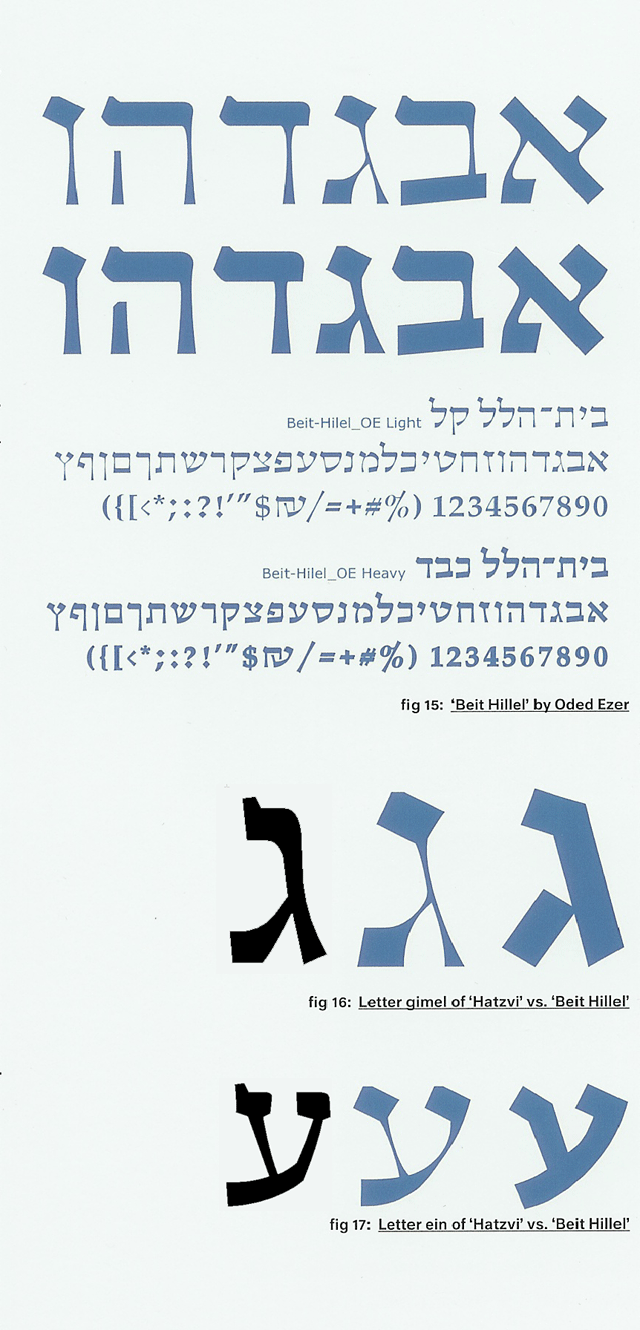
<p>Although Ezer has designed several commercial typefaces that I would love to get my hands on an explore, I thought I would focus here on pieces that display his more experimental side. One project described early in the book is a font called "Bet Hillel" intended as an homage and re-imagining/reconstruction of the venerable "Ha-Tzvi" face. I should note that although Ha-Tzvi has fallen out of favor today, it is among the faces I use when I want to evoke a feeling of Israel through the Fifties, even through the Sixties. It is a wonderfully unsubtle monoline expression of "gavriut"&mdash;"manliness"&mdash;and nicely evokes Uzi ben Gibor. What struck me about Ezer's "Bet Hillel" font, however, is that while the "serifs" (Is this term really appropriate? Is it really the term used by Hebrew typographers to describe the terminating strokes attached to Hebrew letters, as used in one of the articles about Ezer's type included with his book?), anyway, while the serifs follow Ha-Tzvi, the curve and feel of the letters offers homage much more closely to Friedlander's "Hadassah." I have taken the liberty of adding, therefore, a couple of quick scans of Hadassah to a detail grabbed from the book. (Click the excerpt to see a full sample of "Bet Hillel".)</p>

<p><a href="http://www.ivritype.com/hebrew/images/oe-beit-hillel.gif"><img src="http://www.ivritype.com/hebrew/images/oe-beit-hillel-detail.gif" alt="Detail showing Hadassah, Bet-Hillel, Ha-Tzvi" width="420" height="211" border="0"></a></p>
]]>
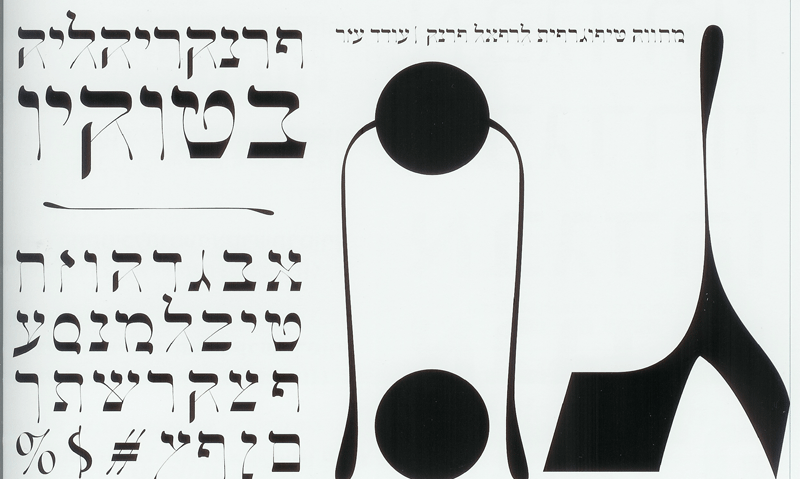
        <![CDATA[<p>I would also be remiss if I didn't include Ezer's deconstruction of Frank R&uuml;hl, the Art Deco face that can not only be said to have moved Ashkenazic Hebrew typography in the direction of readability, but which is as ubiquitous for Hebrew, Ladino, and Yiddish work as the <em>London Times</em> once "New Roman" (it has been replaced by the <em>Times</em> twice in recent decades, a subject for another blog or blog post). Here is a specimen for "Frankr&uuml;hliah" (created 2001&ndash;2003):</p>

<p><a href="http://www.ivritype.com/hebrew/images/oe-frankruehliah.gif"><img src="http://www.ivritype.com/hebrew/images/oe-frankruehliah-detail.gif" alt="A look at Frankruehliah" width="306" height="182" border="0"></a></p>

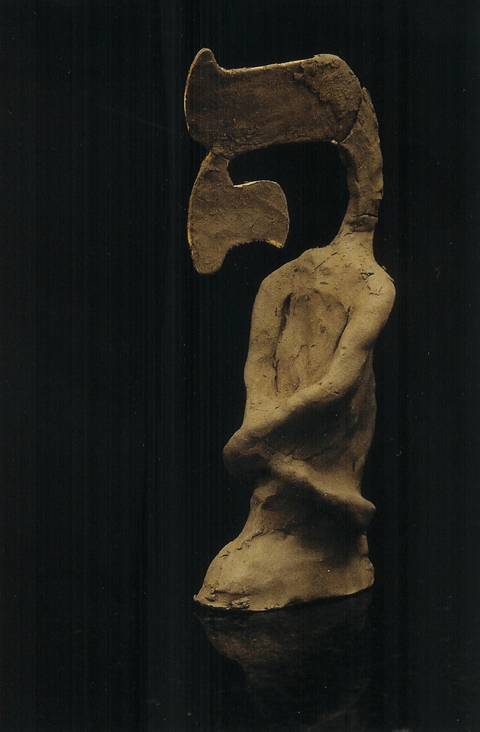
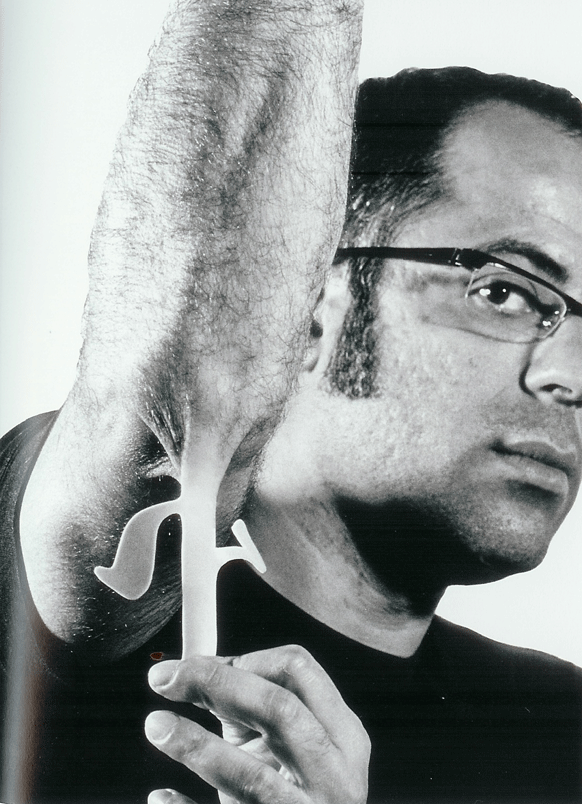
<p><a href="http://www.ivritype.com/hebrew/images/oe-typo-mythologies.gif"><img src="http://www.ivritype.com/hebrew/images/oe-typo-mythologies-0.gif" alt="from Oded Ezer, 'Typo Mythologies'" width="192" height="293" align="left" vspace="6" hspace="6" border="0"></a><a href="http://www.ivritype.com/hebrew/images/oe-typoplastic-surgeries.gif"><img src="http://www.ivritype.com/hebrew/images/oe-typoplastic-surgeries-0.gif" alt="from Oded Ezer, 'Typo Mythologies'" width="146" height="201" align="right" vspace="6" hspace="6" border="0"></a>Finally, I want to encourage everyone to get the book to read about, and to feast your eyes on the three-dimensional quality of much of Ezer's work. Here, for instance, is a picture of a piece from "Typo Mythologies" (to my left) and another from "Typoplastic Surgeries":</p>

<p>I also want to add one critical missing bit of information not present in the <em>Forward</em> article, nor in the book: You can find Ezer's work at his website, <a href="http://www.ezerdesign.com/">www.ezerdesign.com</a></p>]]>
    </content>
</entry>

<entry>
    <title>more Commentary on the Koren siddur</title>
    <link rel="alternate" type="text/html" href="http://www.ivritype.com/hebrew/2009/08/more-commentary.php" />
    <id>tag:www.ivritype.com,2009:/hebrew//6.8168</id>

    <published>2009-08-12T17:55:10Z</published>
    <updated>2009-08-16T18:28:34Z</updated>

    <summary>From the Jewish music &quot;Blog in Dm&quot;: The Koren Siddur on Yedid Nefesh. According to the author, &quot;Hasidic Musician,&quot; the version of ידיד נפש goes back to the original manuscript which eliminates some translation difficulties and makes for what he...</summary>
    <author>
        <name>Ari Davidow</name>
        
    </author>
    
        <category term="links" scheme="http://www.sixapart.com/ns/types#category" />
    
        <category term="typography" scheme="http://www.sixapart.com/ns/types#category" />
    
    
    <content type="html" xml:lang="en" xml:base="http://www.ivritype.com/hebrew/">
        <![CDATA[<p>From the Jewish music "Blog in Dm": <a href="http://blogindm.blogspot.com/2009/08/koren-siddur-on-yedid-nefesh.html">The Koren Siddur on Yedid Nefesh</a>. According to the author, "Hasidic Musician," the version of ידיד נפש goes back to the original manuscript which eliminates some translation difficulties and makes for what he considers to be a more beautiful poem. </p>

<p>Check it out!</p>]]>
        
    </content>
</entry>

<entry>
    <title>Israeli Typographer, Oded Ezer, profiled in The Forward</title>
    <link rel="alternate" type="text/html" href="http://www.ivritype.com/hebrew/2009/08/israeli-typogra.php" />
    <id>tag:www.ivritype.com,2009:/hebrew//6.8167</id>

    <published>2009-08-09T17:06:58Z</published>
    <updated>2009-08-09T17:10:30Z</updated>

    <summary>There is an interesting article about Israeli type designer and artist Oded Ezer in a recent edition of The Forward. Although the author does not appear greatly knowledgeable about Hebrew typography, Glinter is to be commended for writing about the...</summary>
    <author>
        <name>Ari Davidow</name>
        
    </author>
    
        <category term="links" scheme="http://www.sixapart.com/ns/types#category" />
    
        <category term="typography" scheme="http://www.sixapart.com/ns/types#category" />
    
    
    <content type="html" xml:lang="en" xml:base="http://www.ivritype.com/hebrew/">
        <![CDATA[<p>There is an interesting article about Israeli type designer and artist Oded Ezer in a recent edition of <em>The Forward</em>. Although the author does not appear greatly knowledgeable about Hebrew typography, Glinter is to be commended for writing about the subject, and for conveying the idea that fonts are fascinating.</p>

<p><a href="http://www.forward.com/articles/110351/">A Bubbling Font of Creativity: Oded Ezer and His Hebrew Designs</a><br />
By Ezra Glinter<br />
Published July 22, 2009, issue of July 31, 2009.</p>]]>
        
    </content>
</entry>

<entry>
    <title>New &quot;Koren Siddur&quot; features new face, elegant design</title>
    <link rel="alternate" type="text/html" href="http://www.ivritype.com/hebrew/2009/08/new-koren-siddu.php" />
    <id>tag:www.ivritype.com,2009:/hebrew//6.8166</id>

    <published>2009-08-09T16:57:56Z</published>
    <updated>2009-08-09T17:06:46Z</updated>

    <summary>Here is a very good article about the new Koren Siddur, which I now have in hand. It is a beautiful book, and will surely take it&apos;s place alongside my treasured Jerusalem TaNaKh. Prayer Type How Eliyahu Koren used typography...</summary>
    <author>
        <name>Ari Davidow</name>
        
    </author>
    
        <category term="links" scheme="http://www.sixapart.com/ns/types#category" />
    
        <category term="typography" scheme="http://www.sixapart.com/ns/types#category" />
    
    
    <content type="html" xml:lang="en" xml:base="http://www.ivritype.com/hebrew/">
        <![CDATA[<p>Here is a very good article about the new Koren Siddur, which I now have in hand. It is a beautiful book, and will surely take it's place alongside my treasured Jerusalem TaNaKh.</p>

<p><strong>Prayer Type</strong><br />
<a href="http://www.tabletmag.com/life-and-religion/8297/prayer-type/">How Eliyahu Koren used typography to encourage a new way to pray</a><br />
BY JOSHUA J. FRIEDMAN</p>

<p>It will come as no surprise that the new siddur was set by Jerusalem typographer Raphael Freeman. It is also one of the rare siddurim not to put English and Hebrew in "dueling" position&mdash;instead, the two languages work together, reading out from a common spine.</p>

<p>Many thanks to Josh Friedman for noticing the book and writing about it with some knowledge and depth.<br />
</p>]]>
        
    </content>
</entry>

</feed>